
No More Server Rooms: How Cloud Email Became a Full Productivity Suite
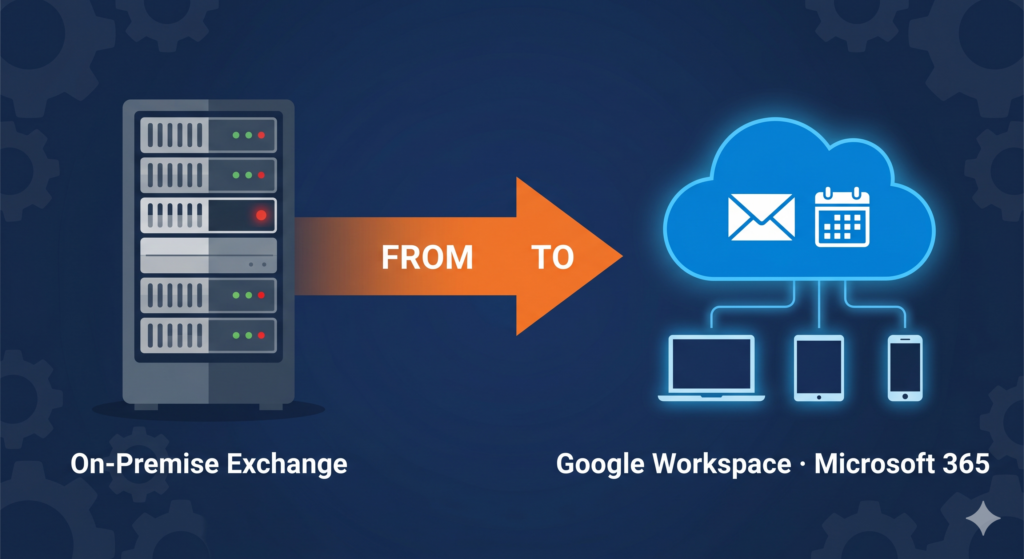
The era of managing physical servers just to send an email is officially dead. What started as a basic electronic messaging tool has evolved into comprehensive, cloud-based workgroup platforms that run entire organizations.
Google led the initial charge by offering small businesses a cloud-native alternative to massive hardware investments. Microsoft has since aggressively pivoted its legacy empire into an accessible, low-barrier cloud ecosystem, sparking a fierce competition that ultimately benefits businesses of all sizes.
Here is how the shift from on-premise email to modern productivity suites unfolded.
The Heavy Lift of the Past: On-Premise Exchange
Two decades ago, if an organization wanted enterprise-grade email, shared calendars, and global address books, the default answer was Microsoft Exchange. But that capability came with a staggering barrier to entry.
Deploying an Exchange environment wasn't just a software purchase — it was a capital expenditure project. A business had to buy physical server hardware, install Windows Server, purchase Exchange Server software, and buy Client Access Licenses (CALs) for every single user. Add in the cost of server racks, cooling, backup tapes, and the specialized IT staff required to keep it all running, and the costs quickly skyrocketed into the tens of thousands of dollars.
Because of this massive upfront investment, true enterprise email and collaboration were often restricted to large corporations. Small businesses, non-profits, and educational institutions were frequently priced out, left to rely on basic, disconnected POP3/IMAP email accounts provided by their web hosts.
Google's Cloud-First Disruption
Google recognized this massive gap in the market. In 2006, they launched Google Apps for Your Domain — which eventually evolved into G Suite, and now Google Workspace.
Google's approach was entirely cloud-native. There were no servers to buy, no licenses to track, and no software to patch. A small business or school could simply point their domain to Google, pay a low monthly per-user fee, and instantly gain access to Gmail, Google Calendar, and Google Docs.
This model democratized enterprise IT. It specifically targeted the sectors Microsoft had historically priced out:
- Small Businesses — could spin up a professional, collaborative environment in an afternoon for a few dollars a month.
- Educational Institutions — Google offered its suite for free to schools, capturing a generation of digitally native users who grew up collaborating in Google Docs instead of Microsoft Word.
- Non-profits — benefited from heavily discounted access to top-tier collaboration tools.
Google shifted the paradigm from email as infrastructure to collaboration as a service.
Microsoft's Pivot: The Cloud Workgroup
Microsoft didn't stay tethered to hardware for long. Recognizing the existential threat posed by Google's low-barrier entry, Microsoft executed one of the most successful pivots in tech history — transitioning from selling boxed software to a cloud subscription model.
Today, Microsoft 365 is a direct, cloud-native competitor to Google Workspace, but it leverages Microsoft's deep history in enterprise management. Microsoft took the complex, expensive architecture of the past and virtualized it into an accessible ecosystem:
- Exchange Online — the power of legacy Exchange, hosted entirely by Microsoft.
- Entra ID (formerly Azure AD) — cloud-based identity and access management, replacing the need for an on-premise Active Directory server.
- Intune — Mobile Device Management (MDM) and endpoint management delivered from the cloud.
A startup can purchase Microsoft 365 Business Premium licenses and instantly get enterprise-grade email (Exchange Online), device security policies (Intune), single sign-on (Entra ID), and team collaboration (Teams) — without ever touching a physical server.
By eliminating the hardware requirements, both Google and Microsoft have transformed the IT landscape, allowing businesses to focus on the work itself rather than the infrastructure required to support it.
Not Sure Which Platform Is Right for You?
Every business is different. The right platform depends on your existing infrastructure, your team's workflows, your compliance requirements, and your budget. There is no universal answer — but there is a right answer for your organization.
The team at Intuitive Design has helped businesses across Western PA and beyond evaluate, migrate to, and manage both Google Workspace and Microsoft 365 environments. We will assess your current setup, walk you through the tradeoffs, and recommend the platform that actually fits the way you work.
Get in touch with us today and let's figure out the right fit together — no pressure, no jargon, just practical guidance.
Get Expert Help
Have a question about what you just read?
Our team is happy to help — no commitment, no pressure.
Get in Touch